Schools Score Highest on Tools and Lowest on Thinking
Part one of three on Gallup’s 2026 education findings.
The number everyone is quoting
On September 8, Gallup published Satisfaction With K-12 Education Hits New Low. Within a day the finding was circulating in roughly the form LinkedIn News gave it: “K-12 parents’ school satisfaction hits a record low,” followed by 32%.
The 32% is real. It is not a number about parents.
Gallup asked all American adults how satisfied they are with the quality of K-12 education in the United States. 32% said completely or somewhat satisfied; 67% said dissatisfied, the highest Gallup has recorded in 27 years of asking. Gallup then asked parents a different question: how satisfied they are with the education their own child is receiving. That answer was 66%.
Both are record lows. They are not the same finding, and one of them is a far better instrument than the other.
One caveat the coverage skipped. The parent figure rests on small subsamples — 233 parents in the telephone poll, with a margin of error around ±8 points — and the previous low was 67%, set in 2013. A one-point move inside an eight-point margin is a record in the technical sense and a flat line in every other. The long trend is not ambiguous, though. The same measure was 83% in 1999.
What Gallup asked next
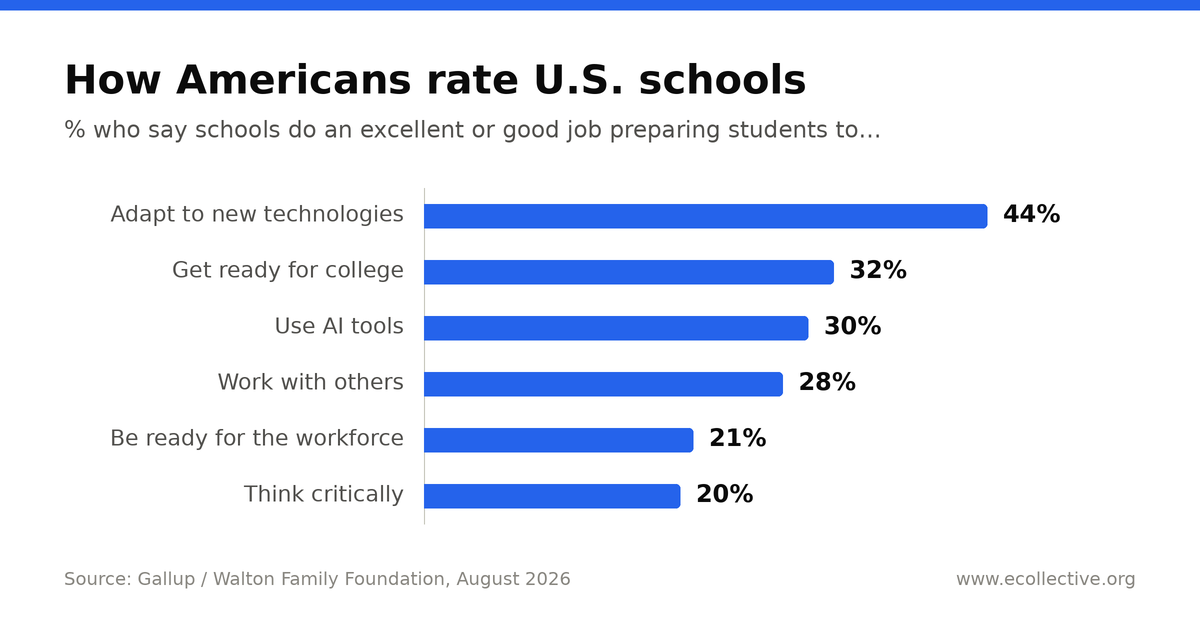
The more useful part of the release sits below the headline. Gallup asked Americans to rate how good a job schools do at preparing students for six specific things. The share saying “excellent” or “good”:
| Preparing students to… | Excellent/good |
|---|---|
| Adapt to new technologies | 44% |
| Get ready for college | 32% |
| Use AI tools | 30% |
| Work with others | 28% |
| Be ready for the workforce | 21% |
| Think critically | 20% |
Now read the bottom of that list against the top of it.
Only 17% rate schools poor on adapting to new technologies. On workforce readiness, 38% say poor. On critical thinking, 47% say poor — the one item on the list where “poor” is the plurality verdict. Americans are not saying schools are mediocre at teaching thinking. They are saying schools are bad at it.
The two things schools score highest on are things a district can buy. The two they score lowest on are things that have to be built.
Parents rate their schools higher on every item, as you would expect from people looking at a real building rather than an idea: 51% on technology, 29% on critical thinking, 27% on workforce readiness. The widest gaps between parents and non-parents — 13 points each — fall on critical thinking and working with others.
Don’t over-read the headline. Do over-read the items.
The national number moved for reasons that have little to do with classrooms.
Since 2024, satisfaction has fallen 19 points among Democrats, 10 among independents and 6 among Republicans. Democrats now sit at 35%, independents at 32% — both record lows — and Republicans at 25%. The group that fell furthest is still the most satisfied. The schools did not change underneath those three groups at three different rates.
Jack Schneider, who directs the Center for Education Policy at UMass Amherst, put the structural problem plainly to the Associated Press: when people weigh in on the nation’s schools, “what they are commenting on are 98,999 schools that they haven’t set foot in.” Gallup’s own senior education researcher, Zach Hrynowski, was blunter: “People have a general negative vibe about everything in the country right now. People are frustrated, and don’t think any institution is working particularly well.” Gallup’s confidence-in-institutions series shows the same slump across nearly everything it measures.
None of that makes the 32% meaningless. A system loses something real when the public stops believing in it, whatever the test scores say. But it does mean the headline is a reading of the national mood, and the item ratings are a reading of schools. The item ratings are where the information is.
Adoption is outrunning pedagogy
Put two of Gallup’s findings side by side and they sit badly together.
Schools score highest of all on adapting to new technologies (44%), and third-highest on using AI tools (30%). They score lowest on critical thinking (20%).
Meanwhile, in a Gallup and Walton Family Foundation survey of teachers released in May, 52% said AI would decrease students’ critical thinking. Six in ten teachers were already using AI in their own work. Only about one in three said their school had a formal policy on student AI use, and 23% said there was one covering teachers. Asked separately, Gen Z is not convinced that AI helps their learning either.
So the fastest-moving tool in education is arriving in the exact area the public already rates schools weakest, mostly without a policy attached, and largely without the people closest to it believing it helps.
Sarah Reckhow of Michigan State told the AP there is “a ton of debate, discussion and noise about technology and AI in education.” The noise is not the problem. The sequencing is. The tool arrived before the pedagogy did.
The mood is worse than the evidence
It would be easy to read all of this as straightforward decline. The record does not support that.
The bad news is real enough. On the Nation’s Report Card, reading fell again at grades 4 and 8 in 2024, on top of the drop between 2019 and 2022. Roughly a third of 8th graders now score below NAEP Basic in reading, the largest share ever recorded, and about 40% of 4th graders, the largest since 2002. Twelfth-grade math and reading scores, released in September 2025, were the lowest ever reported on either assessment.
But the Education Recovery Scorecard, published in May 2026 by researchers at Harvard, Stanford and Dartmouth, tells a more specific story. Working from state test results for roughly 35 million students in grades 3 through 8, it finds that math rebounded after the pandemic — the annual rate of improvement is back to pre-2013 levels — and that 2025 brought the first signs of a turnaround in reading. Every state that improved in reading between 2022 and 2025 had implemented comprehensive “science of reading” reforms. More than 100 districts are now above pre-pandemic levels in both subjects.
The recovery is also U-shaped. The highest- and lowest-income districts have gained the most; the middle has been left behind. Chronic absenteeism has fallen three years running — from a peak of 28.5% in 2022 to about 23% in 2024–25 — but it is still well clear of the 15% that was normal before the pandemic, and the improvement is decelerating: nearly 3 points in 2023, just over 2 in 2024, just under 1 in 2025. AEI’s Return to Learn tracker warns that on this trajectory about half the pandemic-related increase could become the long-term baseline.
The system is not uniformly failing. It is unevenly succeeding. Targeted, evidence-based reform demonstrably works, and the reading states are the proof. What has come apart is the link between how schools perform and how people feel about them.
Meanwhile, families are moving
Opinion is one thing; behavior is another. Public school enrollment fell in 40 states between fall 2019 and 2024, with 16 of them losing at least 5% of their students. Over roughly the same stretch, the share of students being homeschooled rose from 2.8% in fall 2019 to an estimated 3.4% by fall 2022. And 2025, in EdChoice’s summary, “is the year educational choice programs offering universal eligibility became the standard.”
Exit used to be expensive and unusual. It is now neither.
That turns the question around. It is no longer whether families will leave. It is what they find when they do. If the public’s specific complaint is that schools do not teach thinking and cannot show their results, then an alternative that also does not measure outcomes has not solved the problem. It has relocated it.
What we are building against these numbers
The four items Americans rate lowest map almost exactly onto four of the Six E’s:
- Thinking critically (20%) → Evidence: check the claim, so claims can be checked rather than taken on authority
- Being ready for the workforce (21%) → Experience: learn by doing, and leave with something to show for it
- Working with others (28%) → Expression: share and teach
- Getting ready for college (32%) → Expertise: prove what you know, and the proof is in the work
That mapping is not a coincidence, and it is not a claim to have solved anything. It is why the initiatives are shaped the way they are.
Open Degree is live: a free, open, crowdsourced curriculum built so that skills, outcomes and credentials travel across schools, platforms and careers, with clear outcomes, evidence-based assessments and verifiable micro-credentials you truly own. It exists because the complaint underneath the college-readiness and workforce numbers is not really about content. It is that nobody can show their work. Outcomes should be measured and published rather than assumed.
InstructOS is in development: a model and set of tools for turning what you know into a course, a lesson or a mini degree, even if you have never taught or designed a curriculum, with everything mapped underneath to a knowledge graph so learners move through topics the way understanding actually connects. The model exists and the web tools are live — you can map a subject, write the lessons, and publish or export the result. Learner accounts with enrollment and progress, the mobile apps and paid access are not built yet. It is aimed at two groups: teachers who want independence from the school system, and experts who never called themselves teachers. If families are leaving, someone has to teach them.
DIY Degree is live: a guide to building your own learning path, mapping platforms, subjects, standards and regulators so you can find your future faster and more affordably. It is the map for people already navigating their way out.
On the AI question in particular, our position is the one this poll implies. AI should handle the drilling; adults should handle motivation, coaching and character. Compressing the fundamentals is what frees the rest of the day for projects, real work and exactly the kind of thinking 47% of Americans say schools are bad at. Used the other way round, as a faster way to produce answers, it makes the problem the poll identified worse — and the teachers saying so are right.
Mastery over seat time. Skills over credentials.
“The world doesn’t need more degrees. It needs more capable people, and a way for anyone to become one.”
This is the first of three pieces on the Gallup findings. Part two, The 34-Point Gap, takes up the distance between how parents rate their own child’s school and how they rate the nation’s. Part three, Dissatisfaction Is Turning Into Departure, looks at where families are actually going and what the alternatives owe them.
If you are building toward the same thing, get in touch.