Dissatisfaction Is Turning Into Departure
Part three of three on Gallup’s 2026 education findings. Part one covers what Americans say schools are actually bad at; part two, the gap between how parents rate their own school and the nation’s.
Opinion is one thing
Polls measure what people say. Enrollment measures what they do, and the two have stopped agreeing.
Public school enrollment fell in 40 states between fall 2019 and 2024, with 16 of them losing at least 5% of their students. Some of that is demographic — there are simply fewer children — but not all of it. Over roughly the same period the share of students being homeschooled rose from 2.8% to an estimated 3.4%.
And the policy environment changed underneath all of it. 2025 was, in EdChoice’s summary, “the year educational choice programs offering universal eligibility became the standard.”
The scale is no longer marginal. Arizona’s education savings account program passed 100,000 students in January 2026. Florida’s programs serve more than half a million. Texas, in the first year of its new program, signed up more than 101,600 families by mid-August, with more than 100,000 students still on the waiting list.
Leaving used to be expensive and unusual. It is now neither.
Who is actually moving
The Texas numbers repay a closer look, because they complicate the story everyone tells about them.
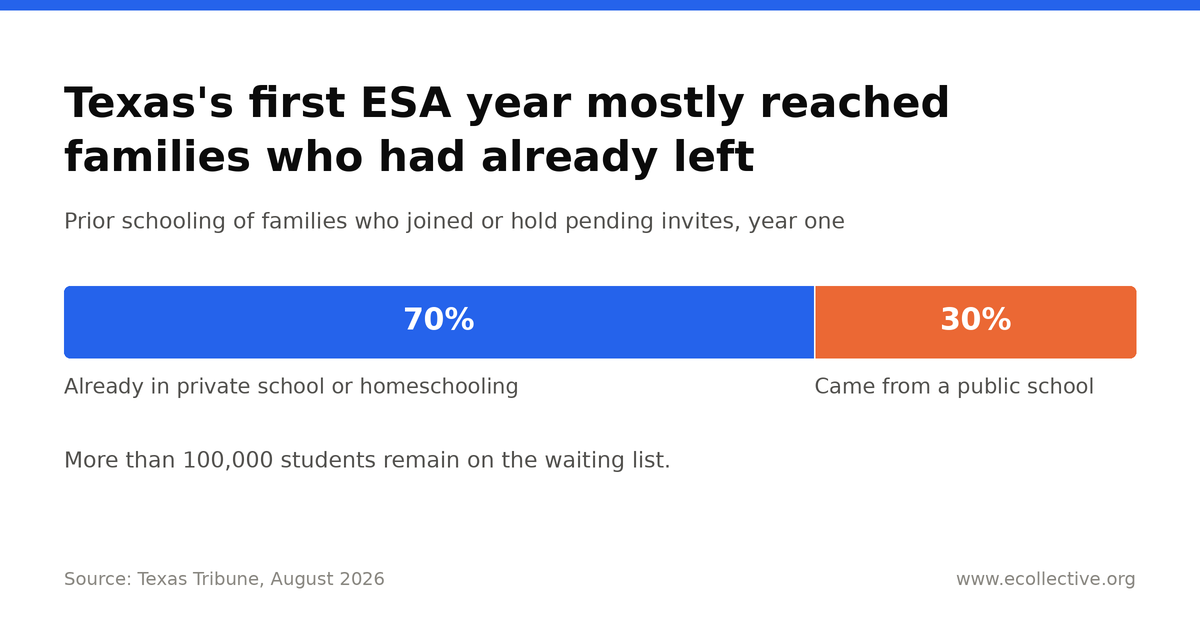
About 70% of the families who joined or hold pending invitations were already in private school or homeschooling. Only around 30% of that same group came from a public school.
Read that against the framing the programs are usually argued from, in either direction. This is not, in its first year, a mass exodus from public schools. It is mostly a subsidy for families who had already left, plus a real but smaller group of new departures — with more than 100,000 students still waiting behind them, which suggests the demand is genuine and not yet met.
Both of the confident stories about ESAs are therefore a little ahead of the evidence. They are not emptying public schools at the pace their critics fear. They are also not, yet, primarily functioning as an escape hatch for the families who most need one.
What we know about what happens next
This is where the record gets thin, and it is the part that matters most.
The early, small, tightly targeted voucher programs of the 1990s and 2000s showed modest gains for participants. The newer and much larger programs have not repeated that.
Evaluations in Louisiana, Indiana and Washington, D.C. found neutral to negative effects on achievement, particularly in math, and particularly in the first year after transferring. In Louisiana, researchers attributed the decline in part to low-quality private schools that the state had approved into the program. Longer-run outcomes look better — differences in college enrollment between participants and their public school peers are minimal — but the achievement results are not what the programs were sold on.
And the most important caveat is the simplest one: the newest programs are essentially unstudied. Almost all of that research examined older, smaller voucher programs. The universal ESAs now enrolling hundreds of thousands of students are too new to have produced evidence either way.
We are running the largest change in American school funding in decades, and we will not know what it did for years.
Most of these programs cannot tell you
Part of the reason we will not know is that many programs are not built to find out.
Accountability varies enormously by state. Some require an annual nationally normed test for participating students. Some require a portfolio reviewed by an approved evaluator. Some require an annual evaluation showing progress “commensurate with ability,” with several acceptable methods. Some require essentially nothing beyond documentation kept by the family. Families transferring a child with disabilities out of a public school may also be waiving federal protections that came with it.
There are respectable arguments for a light touch. Testing regimes shape what gets taught, and one of the reasons families leave is that they do not want their child’s year organized around a state assessment. Nobody should want to rebuild the thing they left.
But there is a difference between declining to impose a state test and declining to know whether anything worked. A family choosing a school deserves to be able to compare it to another one. That is not an accountability regime. That is basic consumer information, and in most of these markets it does not exist.
If the complaint that started all this is that schools do not teach thinking and cannot show their results, an alternative that also cannot show its results has not solved the problem. It has relocated it.
The unbundling nobody planned
There is a second shift inside the first one, and it gets almost no attention.
These programs are not only paying for a different school. In most states the money can be spent on pieces: tutoring, curriculum, therapies, individual courses, testing fees. Texas funds a private school student at roughly $10,500 a year, a student with disabilities at up to $30,000, and a homeschooling family at up to $2,000. That last figure does not buy a school. It buys components.
What that produces is not really school choice as it was argued about for twenty years. It is unbundling. A family with $2,000 and a curious eleven-year-old is not selecting an institution; they are assembling an education from parts — a math program here, a co-op two mornings a week, a community college class at fifteen, a mentor who does the actual work for a living.
This is the part of the shift that looks most like where learning was already heading, and the part the system is least equipped to serve. Assembling an education from parts requires knowing what the parts are, how they connect, what order they go in, and whether the child has actually learned any of it. Nobody hands you that. A family doing this well is doing a job that a school district employs specialists to do.
The demand is arriving well ahead of the tools.
The bottleneck moved
For twenty years the constraint on school choice was permission. Could you leave, and could you afford to?
That constraint is largely gone. What replaced it is harder.
Supply. Good teaching is scarce, and legislation does not create it. A state can fund 100,000 seats in a year; it cannot conjure 100,000 good places to sit. Texas’s waiting list is partly a funding cap and partly the plainer problem that the schools people want to move to are full. Meanwhile the people best equipped to teach are not evenly distributed, and a great many of them are not in classrooms at all.
Proof. A family leaving a school they can see for one they cannot has traded a known quantity for a described one. Without portable, comparable evidence of what a student has actually learned, that trade is made on brochures and word of mouth.
Neither of those is a policy problem, exactly. You cannot legislate your way to more good teachers or to credible evidence of learning. They are build problems.
What we are building
None of this is an argument against leaving. Families are entitled to make that call, and increasingly they can. It is an argument that exit is a means rather than a result, and that what makes it worth doing is the thing on the other side.
Two of those pieces are what the collective is working on.
Open Degree is the proof half: a free, open, crowdsourced curriculum built so that skills, outcomes and credentials are portable across schools, platforms and careers, with clear outcomes, evidence-based assessments and verifiable micro-credentials you truly own. Portable is the operative word. A credential that only means something inside the institution that issued it is no use to a family who has just left an institution. What a student can actually do should travel with the student.
InstructOS is the supply half. It is in development: a model and set of tools for turning what you know into a course, a lesson or a mini degree, even if you have never taught or designed a curriculum, with everything mapped underneath to a knowledge graph so learners move through topics the way understanding actually connects. The model exists and the web tools are live — you can map a subject, write the lessons, and publish or export the result. Learner accounts with enrollment and progress, the mobile apps and paid access are not built yet. It is aimed at teachers who want independence from the school system, and at experts who never called themselves teachers. If a hundred thousand families a year are going to need somewhere else to learn, somebody has to build it, and it will not only be schools.
DIY Degree is live, and is the nearest-term of the three: a guide to building your own learning path, mapping platforms, subjects, standards and regulators so you can find your future faster and more affordably. It is a map for people already in motion.
The through line
Three posts, one argument.
Americans rate schools worst at teaching people to think and at showing what they can do. Parents rating their own school agree, which is what makes it credible. And the families acting on that judgment are moving into a market that mostly cannot answer the question they left over.
Mastery over seat time. Skills over credentials. Outcomes measured and published rather than assumed.
“The world doesn’t need more degrees. It needs more capable people, and a way for anyone to become one.”
If you are building toward the same thing, get in touch.